Showing posts with label #PromotingWellBeing. Show all posts

Tuesday, January 26, 2021

Supporting Teacher Well being


Positive school leadership that supports teacher wellbeing

Rachel Cann, University of Auckland

“Teachers are the most precious resource that we have in our education system, but too often we fail to treat them as ‘taonga’ [treasures] but as a means to an end.” (Cameron et al., 2007)

Concerns about poor teacher wellbeing, and the resulting consequences for education systems in terms of low-quality teaching and teachers leaving the profession, are global issues. In New Zealand, teachers’ concerns about their working conditions and wellbeing were evident in the ‘megastrike’ of mid-2019. There is a plethora of research investigating negative states of teacher wellbeing (for example, teacher burnout), yet in comparison little research investigates how to increase teacher wellbeing.

My research

For my masters’ thesis, I focused on the ways in which teacher wellbeing could be enhanced. I used the lens of positive psychology, which seeks to “understand and build the factors that allow individuals, communities, and societies to flourish.” The research to date on enhancing teacher wellbeing generally focuses on changing individual teachers’ habits or actions through interventions such as learning mindfulness, or stress management skills. However, there is little research on how the school environment could be optimised to enhance teacher wellbeing. Therefore, I decided to focus on the role that schools can play in enhancing teacher wellbeing through answering the research question: How do educational leadership practices influence teacher wellbeing?

Data collection

The research was conducted at one secondary school in an urban area of New Zealand. Two phases of data collection were employed – a survey that measured teacher wellbeing, followed by interviews with six teachers. The survey used a scale based on positive psychology theory (the PERMA-profiler) that generated a teacher wellbeing score between 1 and 10. The scores were used to select three ‘high wellbeing’ and three ‘low wellbeing’ teachers, in order conduct a comparative case study, as understanding the extremes of teachers experiences of wellbeing allowed for a greater understanding of the phenomenon.

The six case study teachers participated in interviews, where I explored teachers’ own definitions of wellbeing, the actions they took to enhance their wellbeing, and their perceptions about school influences on their wellbeing. The following sections summarise the key findings.

Teachers’ definitions of wellbeing and wellbeing habits

Most teachers defined wellbeing as broad and multidimensional, encompassing mental, emotional and physical aspects. The main difference between the high wellbeing and low wellbeing teachers was the way in which high wellbeing teachers were able to talk enthusiastically about examples that illustrated their high wellbeing, such as self-care habits and healthy coping strategies to manage stress. For example, one high wellbeing teacher noted:

“Keeping up my fitness really helps with those endorphins, and you know, I just feel better after my run and keeping fit, it kind of de-stresses me at the end of the day” (Teacher F).

In contrast, low wellbeing teachers tended to comment on having decreased their time spent on hobbies or exercise, and were more prone to ruminating about stressful events.

Circumstances that impacted wellbeing

Teachers’ individual circumstances varied, and impacted wellbeing in different ways – for example, family could be a source of stress or a source of support. Teachers also commented on how school-based factors such as supportive colleagues and good relationships with students had positive impacts on their wellbeing. A good work-life balance was mentioned as important for wellbeing, but the degree to which teachers felt a sense of agency around this varied. Some teachers felt able to put boundaries around work, but others felt school work encroached too much on their home life.

School leaders’ actions that enhance teacher wellbeing

Whilst there are not distinct boundaries between the actions that teachers can take to enhance their own wellbeing and the actions that are the responsibility of schools, there were three clear themes that emerged about how school leaders’ actions impact teacher wellbeing.

1. The importance of teachers feeling that they are valued

Teachers all talked about the importance of appreciation, recognition, and feeling valued in contributing to their wellbeing. High wellbeing teachers were more likely to comment positively about this, for example leaders’ listening to their views:

“I think they listen to teacher voice, and I think they do value it” (Teacher D).

The same teacher commented on the effects of a lack of recognition in a previous school:

“I kind of really worked hard to make it a wonderful department, we got brilliant results for our students, but still I didn’t get any promotion within that school, and that was a little bit disheartening” (Teacher D).

2. The impact of meaningful professional development

All teachers referred to the potential for professional development to positively impact their wellbeing, with many discussing the sense of achievement they experienced through their own personal and professional growth.

“[The leaders are] really challenging us with that reflective… being reflective on our own practice, you know, that’s stuff’s good” (Teacher C).

However, low wellbeing teachers more frequently expressed a lack of understanding of the content of professional development, or the rationale behind it:

“We are encouraged to just kind of take it step by step, but I don’t know if I fully understand the concepts?” (Teacher B).

3. Enabling teacher agency in decision making and changes

There were clear differences between the low wellbeing and high wellbeing teachers in terms of the degree of agency that they felt in decision making and changes occurring in the school. High wellbeing teachers were confident to approach leaders to ask questions and felt they were listened to:

“We feel part of the solution rather than just being, you know, symbols of the problem.” (Teacher C)

However, low wellbeing teachers more commonly expressed that their views were not taken into account, and they disagreed with the changes occurring in the school:

“Too much change and not seeing the reasons for change. Or it could be someone’s reason for change, but the evidence doesn’t back that up” (Teacher E).

Positive school leadership model

The three themes above were used to construct a new model of positive school leadership that represents the actions that school leaders can take (and develop into habits) that enhance teacher wellbeing.
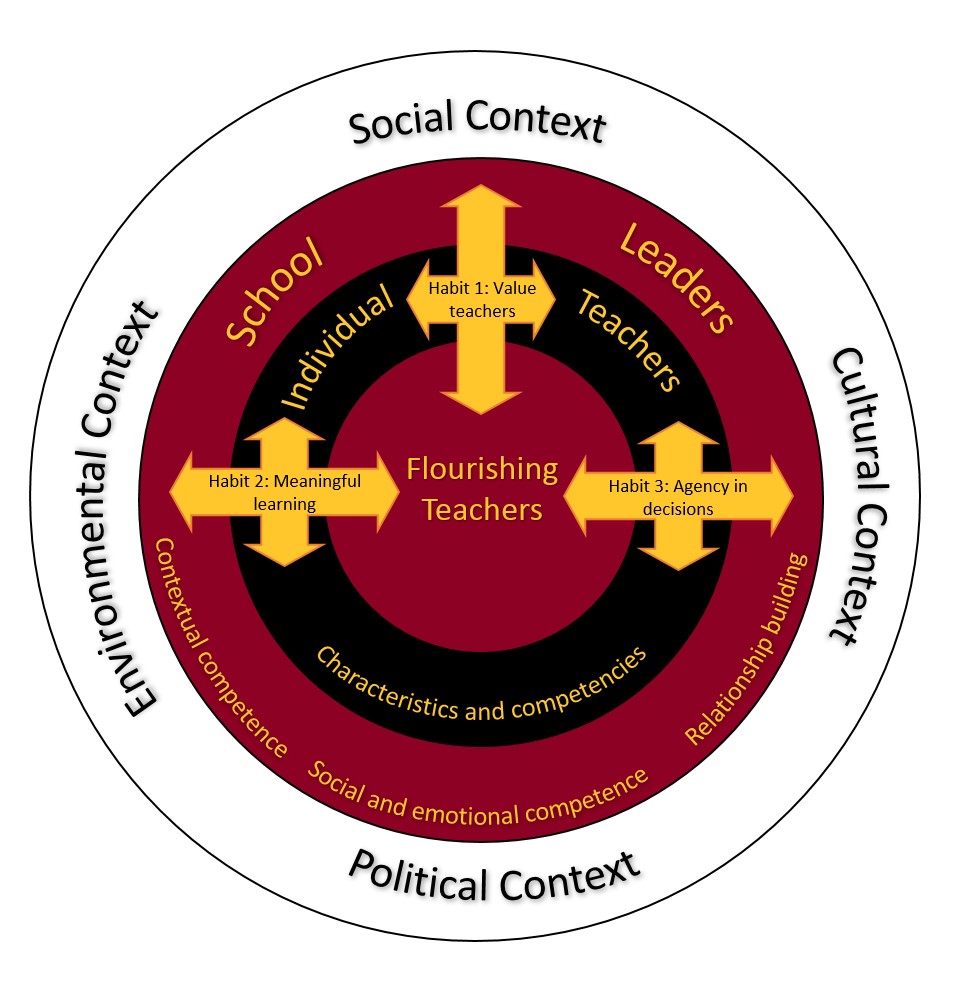
Model of positive school leadership for flourishing teachers. Reprinted with permission from Cann (2019).

Flourishing teachers are placed at the centre of the model, with the surrounding circles and arrows indicating the factors that enable teacher to flourish.

The next level is the individual teachers, and their characteristics and competencies – for example, a teacher’s level of optimism, or coping skills can influence their wellbeing.

The next level are school leaders, and three areas that influence their interactions with teachers: contextual competence (a leader’s ability to understand and respond to context), social and emotional competence, and relationship building.

The outer circle represents contexts that are often outside of teachers or leader’s direct control, for example political context can refer to educational policy.

The three arrows in the model represent leadership habits (actions repeated regularly over time) that can positively influence teachers’ wellbeing:

  • ensuring teachers feel that they are valued,
  • providing meaningful professional development, and
  • enabling teacher agency in decision making and changes.

The three habits are shown interacting with both leaders and teacher’s characteristics and competencies – for example school leaders’ skills in areas such as relationship building, affect the degree to which they are able to successfully enact the habits that can improve teacher wellbeing, and what makes professional development meaningful to a teacher will depend on their existing skills and their own needs. (More information on the model can be found in my thesis here and a journal article here).

Why these findings are important

Teacher wellbeing is not only important to the teachers themselves, but also to the profession as a whole, and ultimately for the students in our education system. Improving teacher wellbeing has the potential to help reduce attrition and ensure quality teaching. A focus on teacher wellbeing has also been identified as a first step in whole-school approaches to improving the wellbeing of students. Whilst some research has explored interventions aimed at improving teacher wellbeing, they are predominantly focused on changing individual teachers’ skills, habits and routines, through practices such as mindfulness, building resilience and managing stress. More research is needed on how school cultures and educator interactions influence wellbeing. This research reinforces the importance of positive relationships for wellbeing, and demonstrates that the quality of leader-teacher interactions has a considerable influence on teacher wellbeing.


Rachel Cann is a PhD student at the University of Auckland. She completed her Master’s thesis on the actions that educational leaders can take to help enhance teacher wellbeing. She continues to explore teacher wellbeing for her doctoral studies, in particular using the perspectives of positive psychology and social network theory. Previously, Rachel was a head of science in an Auckland secondary school, and has also led cross-curricular teams of teachers for project-based learning, pastoral care, and teaching as inquiry.

Tuesday, May 9, 2017

4 Simple Phrases That Instantly Earn People's Trust

 Your team is more likely to thrive if you can make them feel that you are trustworthy.  @SteinbrecherInc CREDIT:
 Project Aristotle is a recent Google study that was undertaken to understand why certain teams in their workplace thrived while others seemed to struggle. After studying hundreds of Google's teams and analyzing years of data, the researchers behind Project Aristotle discovered that "psychological safety" is the secret to building and maintaining successful teams. Amy Edmondson, a Harvard Business School professor, describes psychological safety in her definitive 1999 study as "a team climate characterized by interpersonal trust and mutual respect in which people are comfortable being themselves."
The Google study solidifies what we already know:
 that people need a sense of security to do well at work.
Honesty, transparency, and an overall atmosphere of mutual respect are imperative when building a psychological safety net for your team.
But first, you must earn -- and keep -- their trust. Building trust will allow you to develop meaningful relationships and cultivate an unspoken mutual understanding; your team can count on you to do what you say and say what you mean. In turn, they will do the same for you. This sense of security, precipitated by you, means that your employees' self-esteem is upheld.
A safe haven of trust allows them to speak freely and think more creatively, without feeling rejected or embarrassed. You have the ability to make a significant impact if you engender the trust of your employees. Make it a priority to inject some positivity into each workday. Be aware that your words have the power to sway the opinions and actions of others. If you treat your team members with respect and understanding, interpersonal trust and a sense of security will follow.
Here are some phrases that will instill trust and confidence within your team.
1. "What can I do to help?" When you are truly committed to helping others, it creates a ripple effect. Your team will have more passion to work with you and for you if they believe you have their back.
 Simply saying, "I know that this project is important to you. How can I help?" can move mountains.
 2. "I trust your decision." If your employees feel you trust them to do the right thing, it will boost morale and productivity. Remember, to be trusted, first you must trust.
3. "What can I do differently?" Serve those you're leading, not the other way around. Let people know that their opinions count. Part of your job as a leader is to remove the barriers to success by observing what might be standing in the way of your employees achieving their goals. Determine how you can facilitate their progress without eliminating accountability.
4. "What do you think is our best course of action?" Ask questions versus handing out orders. Considerable insight can be gleaned by asking for someone's opinion. This approach will win the hearts of your team members, as you'll be viewed as a leader who values the perspectives of others and cares enough to ask for feedback. Have faith in the process. Trust the people you lead. Say "thank you" more often, admit when you are wrong, and be open to new ideas.

Friday, April 22, 2016

Dr Jeanette Clarkin-Phillips Transforming a kindergarten’s social, material and cultural capital: “to make the world a better place”.

Dr Jeanette Clarkin-Phillips Transforming a kindergarten’s social, material and cultural capital: “to make the world a better place."
 I did not attend this workshop however Gaylene DP did and was inspired by it in regard to HES. We believe we make a great deal of effort with our parents/caregivers and whanau .. and now we are pushing ourselves to do this even better.
 eg  Met with Refuge coordinator.  
 Pasifika meetings attended.
 Gradually working alongside new young mothers with numerous pre-schoolers. 
Doctoral thesis which explored the affordance networks of families involved with a kindergarten in a ‘vulnerable’ community in Aotearoa New Zealand
Research questions
What has shaped the transformation of the kindergarten as a mesosystem

in the field of early childhood education?
How did this history construct affordances for families and what encouraged the families to recognise and take up these opportunities?
How might the constructs of habitus and affordance assist our understanding of families’ abilities to take up these opportunities?
What implications are there for policies that construct ‘vulnerable’ communities?
TE KURA TOI TANGATA FACULTY OF EDUCATION
waikato.ac.nz/education WHERE THE WORLD IS GOING
Methodology and theoretical framing
Case study of kindergarten 2005-2014
Bourdieu’s logic of practice [(habitus)(capital) + field + practice
Bronfenbrenner’s ecological systems model: macro, exo, meso and microsystems
These two theorists enabled me to understand how things had come to be: historically and currently.

Affordances. (Barab & Roth, 2006; Gee, 2008; Gibson,1979) Affordance theory assisted in making sense of what and how had provided families with opprtunities to realise their aspirations
TE KURA TOI TANGATA FACULTY OF EDUCATION
waikato.ac.nz/education WHERE THE WORLD IS GOING
Definitions
Habitus: “Durable, transposable dispostions, structured structures predisposed to act as structuring structures” (Bourdieu, 1972/1977, p.72)
Ecological systems model: Ecological nature of human development as a set of five nested structures to illustrate and analyse the inseparability of individual and environment.
Affordances: the objects or features of an environment that might be recognised and appropriated by an individual to achieve certain goals (Gee, 2008)
TE KURA TOI TANGATA FACULTY OF EDUCATION
waikato.ac.nz/education WHERE THE WORLD IS GOING
Participants and Data collection methods
Participants General Manager of kindergarten association
Head teacher and two teachers Seven family participants Kindergarten Kaimahi
Data gathering Semi-structured interviews with participants
Field observations Document analysis
TE KURA TOI TANGATA FACULTY OF EDUCATION
waikato.ac.nz/education WHERE THE WORLD IS GOING
The kindergarten in 2003-4: An ecology of the odds
TE KURA TOI TANGATA FACULTY OF EDUCATION
waikato.ac.nz/education WHERE THE WORLD IS GOING
Mandy’s impressions and decisions.
Well I think that there was a general sense of hopelessness about the place and we couldn’t pin-point exactly why. It was a depressed area, people’s attitudes, previous managers’ attitudes to the area was actually that it was more of a hindrance than a help to have the kindergarten. Attendance was really low and it was bleeding financially from every orifice. It had been identified by the previous two general managers as being a kindergarten that was likely to close and that was the opinion of the staff at the time as well they were just waiting around for it to close, to get redundancy, anyway. (Mandy, the General Manager of Kindergarten Association)
TE KURA TOI TANGATA FACULTY OF EDUCATION
waikato.ac.nz/education WHERE THE WORLD IS GOING
The kindergarten in 2014: An ecology of affordances
TE KURA TOI TANGATA FACULTY OF EDUCATION
waikato.ac.nz/education WHERE THE WORLD IS GOING
The Parent Support and Development initiative
2005: A cross-sectorial early intervention programme for vulnerable children and their families.
The main aim of the programme was to “ensure all vulnerable children receive the best support they need from before birth to their transition to school to provide them with the best possible start in life and enable them to maximise their potential” (Office of the Minister for Social Development and Employment, 2004, p. 4).
The four key elements to the programme included improving health, education, and parent support services for vulnerable children and their families through building on existing universal and targeted services as well as improved coordinating, identifying and needs assessing by different agencies.
The kindergarten was one of eight early childhood centres in the pilot project 2006- 2009
TE KURA TOI TANGATA FACULTY OF EDUCATION
waikato.ac.nz/education WHERE THE WORLD IS GOING
My interpretations
The habitus and values of leadership: a commitment to social justice and being true to the values of the organisation provided a vehicle for supporting a failing kindergarten rather than follow the practices of capitalist ideology of closing the loss-making components of an organisation.
Mandy’s habitus: The collective practices, beliefs and values constitutive of the working class environment, which Mandy grew up in, helped structure her habitus.
Caryll’s habitus: The stories recounted by her parents about their early lives and upbringing gave Caryll an appreciation for the impact of circumstances on successive generations and that not everyone had the same opportunities. Caryll felt her early experiences had a significant bearing on the structuring of her values and beliefs.
TE KURA TOI TANGATA FACULTY OF EDUCATION
waikato.ac.nz/education WHERE THE WORLD IS GOING
Disrupting the vulnerability discourse
We want to move away from the risks and results of social isolation and
towards quality early childhood education provision that forms the core of a
multitude of services that enhances the parenting, social and work skills of all
families in that wider community.
(Wellington Region Free Kindergarten Association, December, 2005, p. 2)
Well I don’t think that this community is any more vulnerable than any other community in any other place in New Zealand because everybody can be vulnerable at different stages of their lives so if you’re talking about decile ratings or you wanted to classify people, then I think that vulnerable is the wrong word to use. To me it’s not a term that I think that fits with this community in Taitoko. Because actually the longer you’re here, and the more you get to know the people, there is a very strong community feeling in this area. And everyone brings what they can (Caryll)
TE KURA TOI TANGATA FACULTY OF EDUCATION
waikato.ac.nz/education WHERE THE WORLD IS GOING
Affordances
Significant parent and community involvement.
  • Parent committees
  • Opportunities for employment in the kindergarten setting: administrator, ESW, Kaimahi,
    cook, field-based students Coffee/playgroup
    Involving other services to support aspirations Teachers as mesosystem agents.
    Strong, trusting relationships.
    Culturally responsive and sensitive staff. Qualified, professional staff.

    Flexible, adaptable approach.
TE KURA TOI TANGATA FACULTY OF EDUCATION
waikato.ac.nz/education WHERE THE WORLD IS GOING
Kirstie
Kirstie grew up in Levin, not knowing her father, coping with a mother addicted to gambling, an absent stepfather and having to assume responsibility for her younger sister. When her mother died, Kirstie, then aged 15 years, left school without completing any formal qualifications and found a job at the local fast food outlet. Kirstie had her first child when she was 21 after being in a relationship for a short time. This relationship lasted less than 6 months. In the majority of western countries and Aotearoa New Zealand, in particular, Kirstie would be seen to have the odds stacked against her. She recognised few career opportunities and held few parenting skills. However, despite these ‘odds’, two decades later she is a mother of six children in a long-term relationship, a respected and active member of her community, and has completed a Bachelor of Teaching Early Childhood. Kirstie has to all intents and purposes defied the odds and been able to realise a different life for herself and her children.
TE KURA TOI TANGATA FACULTY OF EDUCATION
waikato.ac.nz/education WHERE THE WORLD IS GOING
Level 1. Recognising an affordance
I guess I didn’t know about kindergarten even though I was aware of it being down the road and I never went to kindergarten as a pre-schooler, [my] kids had always been in daycare fulltime because I had worked about 60 hours a week. (Kirstie, Interview 1).
TE KURA TOI TANGATA FACULTY OF EDUCATION
waikato.ac.nz/education WHERE THE WORLD IS GOING
Level 2. A new field: Encountering different perspectives and developing sets of capacities for action
I just became part of the kindergarten, literally, when I would go in the mornings to drop my kids off I wouldn’t go home I just stayed there and I just hung out, kind of learnt things [about being a parent], met people, and was just supported by Caryll. Being at kindergarten helped me to be confident, getting involved in the kids education, like knowing it was ok to ask questions. (Kirstie,Interview 2)
TE KURA TOI TANGATA FACULTY OF EDUCATION
waikato.ac.nz/education WHERE THE WORLD IS GOING
Level 3. Increasing affordance networks over time
There was a chairperson at the time, of the committee, I think that her child may have gone off to school and there was nobody [to take on the job]. Caryll said “you could do this” and I told her “oh, if you help me” cos I didn’t know what it entailed or anything about it all. I think it gave me a lot of confidence [being on the committee], I was never a really confident type of person and it was being part of the kindergarten and what evolved from that that helped me to be confident. (Kirstie, Interview 1).
TE KURA TOI TANGATA FACULTY OF EDUCATION
waikato.ac.nz/education WHERE THE WORLD IS GOING
Level 4. Replicating affordances
Share what we’ve experienced and let other people feel that. Like they [people in the community] used to say that we’re ‘the hood’ but now you get people from this side of town [referring to other side of railway tracks from the kindergarten] wanting to enrol at our kindergarten and we’ve got waiting lists because like they see this, they see us, they see other people come through our kindy and experience the things that we’ve been able to experience. (Kirstie, Interview 1).
It’s amazing now that I’ve moved on and M who was a mum at the kindergarten, she’s taken it on [making the lunches at the kindergarten even though her child had started school] and I really love that it’s still going other parents are taking over. (Kirstie, Interview 2).
TE KURA TOI TANGATA FACULTY OF EDUCATION
waikato.ac.nz/education WHERE THE WORLD IS GOING
Kirstie’s affordance network
Level 1 Recognising the afordance
Level 2
Minimal Knowledge of kindergarten. Used‘daycare’ for child-minding
while she worked
Caryll suggested she bring her son to
kindergartenafter
seeing him playing on sigde of road
Startedvisitin
kindergarten then children
enroledtoatend
Began
atending cofe/play group
Asked by Caryll to be chairperson of Kindergarten
Becomes an
integral part
of decision-making

‘Hangs out’ regularly at kindergarten.Learnt things, met people & learnt it was okay to
Encounteringdiferent Commite ofcofe/playgroup asknquestios&getinvolved
perspectives& developingsncapacitie
withchildren’senducatio Used skills Initiatedkindergarten ESW
foractio
Level 3
Became kaimahi then ESW
Used skills to encourage other parents to
be involved
Elected to governance board of local primary school
to fund raise
lunch scheme, employed as chef
Increasingafordancee networksovertim
Commencred tertiay
qualnificatio
Level 4
Repligcatin afordances
TE KURA TOI TANGATA FACULTY OF EDUCATION
Sharing her experiences and ensuring ongoing availabilityofafordances
waikato.ac.nz/education WHERE THE WORLD IS GOING
Carmella
Carmella came to be involved in the kindergarten through a friend who had children attending the kindergarten. Carmella was a young parent who came from a family that had high educational expectations for their children. Carmella left home after completing high school to do a one-year qualification in travel and tourism at a Polytechnic. She then returned home and it was at this time she became pregnant and expectations about education changed for Carmella. Her parents articulated to Carmella that she had stepped outside of the realms of acceptable behaviour therefore she had to ‘suffer the consequences’ and give up all ideas of further education.
TE KURA TOI TANGATA FACULTY OF EDUCATION
waikato.ac.nz/education WHERE THE WORLD IS GOING
Level 1. Recognising an affordance
I had to learn once I became a mother, what early childhood education was all about and I think that was just from peers, yeah, one of my friends. She was going to a kindergarten and I thought ‘what is that?’ I really was so naïve as an adult that I hadn’t any idea. I think as a young mum I thought it was drop off - a baby sitting service no one told you any different really. [Then] I started going with my friend to drop her sons off at kindy. (Carmella, Interview 1).
TE KURA TOI TANGATA FACULTY OF EDUCATION
waikato.ac.nz/education WHERE THE WORLD IS GOING
Level 2. A new field: Encountering different perspectives and developing sets of capacities for action
I started going along, so I had a little bit of an insight into watching how they [the teachers] worked together and collaborated with each other and I think at that young age I trusted my best friend. I trusted her judgment “if her kids are there, it will be alright”.
Those teachers that I went to drop them off with, I didn’t know them from a bar of soap and that they didn’t live in the community, I thought [this] was strange. I was quite surprised. (Carmella, Interview 1)
TE KURA TOI TANGATA FACULTY OF EDUCATION
waikato.ac.nz/education WHERE THE WORLD IS GOING
Level 3. Increasing affordance networks over time
It was new to me [coming to kindergarten] and it was a bit intimidating and uncomfortable but she [Caryll] had a nice aura about her, she was very nice and approachable, but I think I tried to avoid her for a few times, I thought I don’t know how to deal with this lady, I don’t know what she’s asking of me really but she was nice enough.
[Caryll] asked if I wanted to be on the committee and I felt a bit more confident and comfortable around her and then finally I thought yeah, that’s a good idea [to be the treasurer] and I can stay at the kindy and see my children. (Carmella, Interview 1).
TE KURA TOI TANGATA FACULTY OF EDUCATION
waikato.ac.nz/education WHERE THE WORLD IS GOING
Level 4. Replicating affordances
We were empowering the community and that’s how we all got to know one another and we probably wouldn’t be here today if it wasn’t for those sorts of connections and links and recognising that family is part of community. It inspires me to do that to others and say “hey look you can be a mother and be a teacher and all sorts and be whatever you want to be and it’s ok and we’re here to help you” and that’s why I think we can be a help because we had the support, it was normal, it was natural. (Carmella,Interview 1).
TE KURA TOI TANGATA FACULTY OF EDUCATION
waikato.ac.nz/education WHERE THE WORLD IS GOING
Carmella’s affordance network
No experience of kindergarten.
Raised in cultural framework of extended family. Thought kindergarten was a

‘drop-of’or‘bgabysitin service’
Friend going to
kindergarten&invitedher
perspectives& Carylaskedhertobetreasurer Caryl’sapproachabilityhelped
Level1
Recognising the
afordance
Started going with friend –
hertofelcomfortable
Sugestedacofe/playgroup bestarted
Level2 Encounteringdiferent
trustedfriends’judgement aboutkindergartenasan alright place for her children
developingsncapacitie ofkindergartencommite foractio
Employed as kindergarten Level3 administrator
Increasingafordancee networksovertim
Level4
Repligcatin af fordances

TE KURA TOI TANGATA FACULTY OF EDUCATION
Begins and completes a teacnhingqualificatio
Employed at ECE centre
Commitedtobuilding relatnios hips and empowering others
Appointed as head teacher at ECE centre at new
teen parent unit
waikato.ac.nz/education WHERE THE WORLD IS GOING
Implications for policy and practice.
Teachers as mesosystem agents
Teachers play a significant role in assisting families to recognise affordances and increase the strength of the affordance, broker opportunities and broker support.
Leadership committed to social justice
Transformed the odds for the families.
Policy implications
Policy decisions need to support the provision and replication of the multiple affordances for families and teachers. Systems and processes at state and local level that prioritise capacity building of teacher and family partnerships will enhance the possibilities for changes in teacher beliefs and attitudes and the development of strong affordance networks. Governments committed to resourcing teachers’ on-going professional learning can contribute to a range of opportunities for the exploration of new perspectives and a challenging of ideological beliefs based on deficit theorising.
TE KURA TOI TANGATA FACULTY OF EDUCATION
waikato.ac.nz/education WHERE THE WORLD IS GOING

Another social justice initiative
http://www.wn-kindergarten.org.nz/innovations/ymen.html
TE KURA TOI TANGATA FACULTY OF EDUCATION
waikato.ac.nz/education WHERE THE WORLD IS GOING