Showing posts with label #PARTNERSHIPS and NETWORKS. Show all posts

Tuesday, January 26, 2021

Supporting Teacher Well being


Positive school leadership that supports teacher wellbeing

Rachel Cann, University of Auckland

“Teachers are the most precious resource that we have in our education system, but too often we fail to treat them as ‘taonga’ [treasures] but as a means to an end.” (Cameron et al., 2007)

Concerns about poor teacher wellbeing, and the resulting consequences for education systems in terms of low-quality teaching and teachers leaving the profession, are global issues. In New Zealand, teachers’ concerns about their working conditions and wellbeing were evident in the ‘megastrike’ of mid-2019. There is a plethora of research investigating negative states of teacher wellbeing (for example, teacher burnout), yet in comparison little research investigates how to increase teacher wellbeing.

My research

For my masters’ thesis, I focused on the ways in which teacher wellbeing could be enhanced. I used the lens of positive psychology, which seeks to “understand and build the factors that allow individuals, communities, and societies to flourish.” The research to date on enhancing teacher wellbeing generally focuses on changing individual teachers’ habits or actions through interventions such as learning mindfulness, or stress management skills. However, there is little research on how the school environment could be optimised to enhance teacher wellbeing. Therefore, I decided to focus on the role that schools can play in enhancing teacher wellbeing through answering the research question: How do educational leadership practices influence teacher wellbeing?

Data collection

The research was conducted at one secondary school in an urban area of New Zealand. Two phases of data collection were employed – a survey that measured teacher wellbeing, followed by interviews with six teachers. The survey used a scale based on positive psychology theory (the PERMA-profiler) that generated a teacher wellbeing score between 1 and 10. The scores were used to select three ‘high wellbeing’ and three ‘low wellbeing’ teachers, in order conduct a comparative case study, as understanding the extremes of teachers experiences of wellbeing allowed for a greater understanding of the phenomenon.

The six case study teachers participated in interviews, where I explored teachers’ own definitions of wellbeing, the actions they took to enhance their wellbeing, and their perceptions about school influences on their wellbeing. The following sections summarise the key findings.

Teachers’ definitions of wellbeing and wellbeing habits

Most teachers defined wellbeing as broad and multidimensional, encompassing mental, emotional and physical aspects. The main difference between the high wellbeing and low wellbeing teachers was the way in which high wellbeing teachers were able to talk enthusiastically about examples that illustrated their high wellbeing, such as self-care habits and healthy coping strategies to manage stress. For example, one high wellbeing teacher noted:

“Keeping up my fitness really helps with those endorphins, and you know, I just feel better after my run and keeping fit, it kind of de-stresses me at the end of the day” (Teacher F).

In contrast, low wellbeing teachers tended to comment on having decreased their time spent on hobbies or exercise, and were more prone to ruminating about stressful events.

Circumstances that impacted wellbeing

Teachers’ individual circumstances varied, and impacted wellbeing in different ways – for example, family could be a source of stress or a source of support. Teachers also commented on how school-based factors such as supportive colleagues and good relationships with students had positive impacts on their wellbeing. A good work-life balance was mentioned as important for wellbeing, but the degree to which teachers felt a sense of agency around this varied. Some teachers felt able to put boundaries around work, but others felt school work encroached too much on their home life.

School leaders’ actions that enhance teacher wellbeing

Whilst there are not distinct boundaries between the actions that teachers can take to enhance their own wellbeing and the actions that are the responsibility of schools, there were three clear themes that emerged about how school leaders’ actions impact teacher wellbeing.

1. The importance of teachers feeling that they are valued

Teachers all talked about the importance of appreciation, recognition, and feeling valued in contributing to their wellbeing. High wellbeing teachers were more likely to comment positively about this, for example leaders’ listening to their views:

“I think they listen to teacher voice, and I think they do value it” (Teacher D).

The same teacher commented on the effects of a lack of recognition in a previous school:

“I kind of really worked hard to make it a wonderful department, we got brilliant results for our students, but still I didn’t get any promotion within that school, and that was a little bit disheartening” (Teacher D).

2. The impact of meaningful professional development

All teachers referred to the potential for professional development to positively impact their wellbeing, with many discussing the sense of achievement they experienced through their own personal and professional growth.

“[The leaders are] really challenging us with that reflective… being reflective on our own practice, you know, that’s stuff’s good” (Teacher C).

However, low wellbeing teachers more frequently expressed a lack of understanding of the content of professional development, or the rationale behind it:

“We are encouraged to just kind of take it step by step, but I don’t know if I fully understand the concepts?” (Teacher B).

3. Enabling teacher agency in decision making and changes

There were clear differences between the low wellbeing and high wellbeing teachers in terms of the degree of agency that they felt in decision making and changes occurring in the school. High wellbeing teachers were confident to approach leaders to ask questions and felt they were listened to:

“We feel part of the solution rather than just being, you know, symbols of the problem.” (Teacher C)

However, low wellbeing teachers more commonly expressed that their views were not taken into account, and they disagreed with the changes occurring in the school:

“Too much change and not seeing the reasons for change. Or it could be someone’s reason for change, but the evidence doesn’t back that up” (Teacher E).

Positive school leadership model

The three themes above were used to construct a new model of positive school leadership that represents the actions that school leaders can take (and develop into habits) that enhance teacher wellbeing.
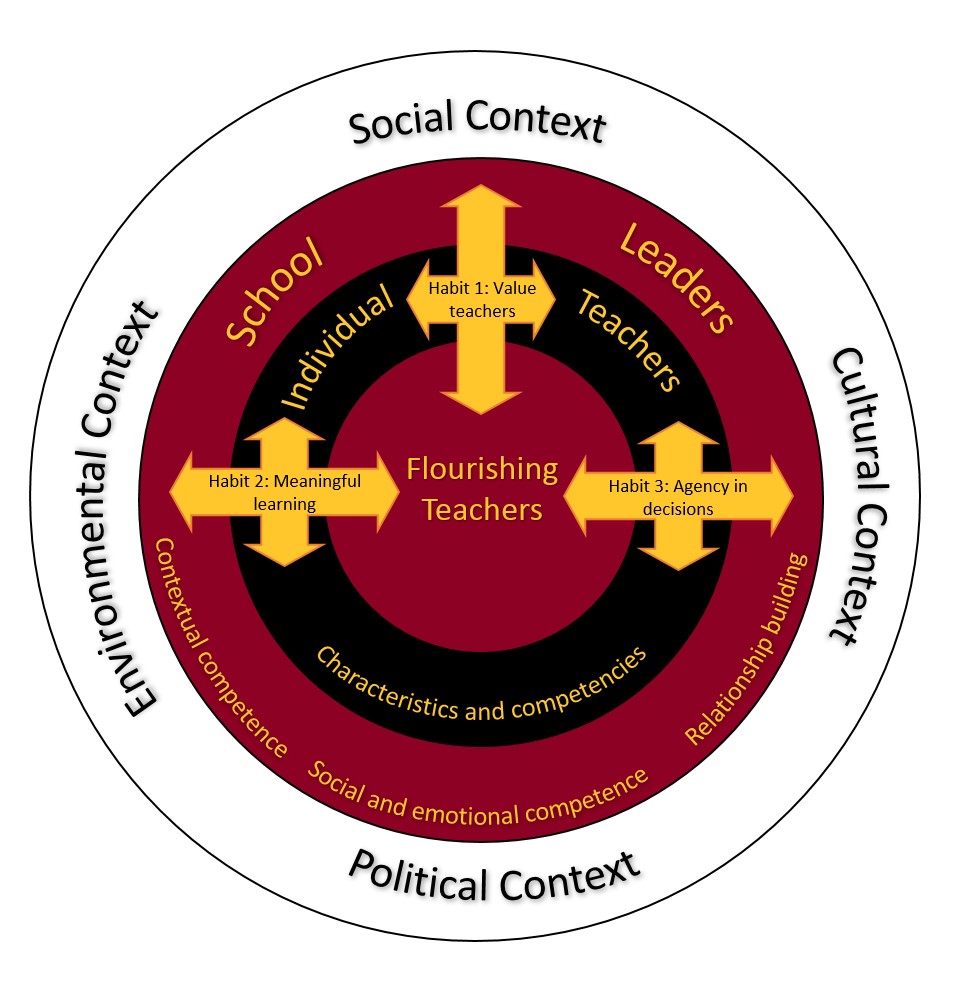
Model of positive school leadership for flourishing teachers. Reprinted with permission from Cann (2019).

Flourishing teachers are placed at the centre of the model, with the surrounding circles and arrows indicating the factors that enable teacher to flourish.

The next level is the individual teachers, and their characteristics and competencies – for example, a teacher’s level of optimism, or coping skills can influence their wellbeing.

The next level are school leaders, and three areas that influence their interactions with teachers: contextual competence (a leader’s ability to understand and respond to context), social and emotional competence, and relationship building.

The outer circle represents contexts that are often outside of teachers or leader’s direct control, for example political context can refer to educational policy.

The three arrows in the model represent leadership habits (actions repeated regularly over time) that can positively influence teachers’ wellbeing:

  • ensuring teachers feel that they are valued,
  • providing meaningful professional development, and
  • enabling teacher agency in decision making and changes.

The three habits are shown interacting with both leaders and teacher’s characteristics and competencies – for example school leaders’ skills in areas such as relationship building, affect the degree to which they are able to successfully enact the habits that can improve teacher wellbeing, and what makes professional development meaningful to a teacher will depend on their existing skills and their own needs. (More information on the model can be found in my thesis here and a journal article here).

Why these findings are important

Teacher wellbeing is not only important to the teachers themselves, but also to the profession as a whole, and ultimately for the students in our education system. Improving teacher wellbeing has the potential to help reduce attrition and ensure quality teaching. A focus on teacher wellbeing has also been identified as a first step in whole-school approaches to improving the wellbeing of students. Whilst some research has explored interventions aimed at improving teacher wellbeing, they are predominantly focused on changing individual teachers’ skills, habits and routines, through practices such as mindfulness, building resilience and managing stress. More research is needed on how school cultures and educator interactions influence wellbeing. This research reinforces the importance of positive relationships for wellbeing, and demonstrates that the quality of leader-teacher interactions has a considerable influence on teacher wellbeing.


Rachel Cann is a PhD student at the University of Auckland. She completed her Master’s thesis on the actions that educational leaders can take to help enhance teacher wellbeing. She continues to explore teacher wellbeing for her doctoral studies, in particular using the perspectives of positive psychology and social network theory. Previously, Rachel was a head of science in an Auckland secondary school, and has also led cross-curricular teams of teachers for project-based learning, pastoral care, and teaching as inquiry.

Wednesday, July 22, 2020

Black Lives Matter Kaupapa Korero Aotearoa context

Attended panel discussion

People, Place and Politics

21st Jul 2020 5:45pm
A conversation about engaging with Black Lives Matter in a Waikato context.
Featuring University of Waikato academics and students, this panel discussion will explore questions raised from a local perspective of the Black Lives Matter movement. This kōrero will cover acknowledging and challenging privilege, the place of monuments, memorialisation and historical reminders, and the power of language in naming conventions as part of reclaiming ownership.
This panel will be facilitated by University of Waikato Deputy Vice-Chancellor Māori,  Sarah-Jane Tiakiwai. Moderated audience questions will form part of the discussion.

Panellists:

Kyla Campbell-Kamariera (Te Rarawa, Te Aupōuri, Taranaki Tūturu), President, Waikato Students’ Union
From rural roots in Northland, Kyla has been described as a trailblazing mana wahine. Currently studying towards a Master of Māori and Indigenous Studies with a particular focus on Māori student politics and the resurgence of mātauranga Māori in mainstream spaces, Kyla’s goals include becoming Vice-Chancellor of the University of Waikato.
Sandra-Lee Ringham (Ngāti Kuri), Teaching Fellow, Doctoral candidate
Sandi’s doctoral thesis explores the geographies of Ngāti Kuri women as they build mana wahine identities and relationships with and in various forms of ‘Nature’ spaces. She teaches Māori and indigenous geographies as well as Māori resource management, giving geography and environmental planning students an understanding of the complexities of colonisation in resource management.
Professor Robyn Longhurst, Deputy Vice-Chancellor Academic
Professor Longhurst has a long-standing interest in gender, equity and social justice. Her research has been in the broad areas of social and cultural geography, with a particular interest in embodiment.  She has taught many classes over the years on expressions of power and meaning in landscapes, including public art, monuments and memorialisation.

Tuesday, May 9, 2017

4 Simple Phrases That Instantly Earn People's Trust

 Your team is more likely to thrive if you can make them feel that you are trustworthy.  @SteinbrecherInc CREDIT:
 Project Aristotle is a recent Google study that was undertaken to understand why certain teams in their workplace thrived while others seemed to struggle. After studying hundreds of Google's teams and analyzing years of data, the researchers behind Project Aristotle discovered that "psychological safety" is the secret to building and maintaining successful teams. Amy Edmondson, a Harvard Business School professor, describes psychological safety in her definitive 1999 study as "a team climate characterized by interpersonal trust and mutual respect in which people are comfortable being themselves."
The Google study solidifies what we already know:
 that people need a sense of security to do well at work.
Honesty, transparency, and an overall atmosphere of mutual respect are imperative when building a psychological safety net for your team.
But first, you must earn -- and keep -- their trust. Building trust will allow you to develop meaningful relationships and cultivate an unspoken mutual understanding; your team can count on you to do what you say and say what you mean. In turn, they will do the same for you. This sense of security, precipitated by you, means that your employees' self-esteem is upheld.
A safe haven of trust allows them to speak freely and think more creatively, without feeling rejected or embarrassed. You have the ability to make a significant impact if you engender the trust of your employees. Make it a priority to inject some positivity into each workday. Be aware that your words have the power to sway the opinions and actions of others. If you treat your team members with respect and understanding, interpersonal trust and a sense of security will follow.
Here are some phrases that will instill trust and confidence within your team.
1. "What can I do to help?" When you are truly committed to helping others, it creates a ripple effect. Your team will have more passion to work with you and for you if they believe you have their back.
 Simply saying, "I know that this project is important to you. How can I help?" can move mountains.
 2. "I trust your decision." If your employees feel you trust them to do the right thing, it will boost morale and productivity. Remember, to be trusted, first you must trust.
3. "What can I do differently?" Serve those you're leading, not the other way around. Let people know that their opinions count. Part of your job as a leader is to remove the barriers to success by observing what might be standing in the way of your employees achieving their goals. Determine how you can facilitate their progress without eliminating accountability.
4. "What do you think is our best course of action?" Ask questions versus handing out orders. Considerable insight can be gleaned by asking for someone's opinion. This approach will win the hearts of your team members, as you'll be viewed as a leader who values the perspectives of others and cares enough to ask for feedback. Have faith in the process. Trust the people you lead. Say "thank you" more often, admit when you are wrong, and be open to new ideas.

Wednesday, March 22, 2017

How to get the Best out of your team / Springboard Alumni

How am I actually developing the capability of my lead team ?

 Leader and coach
  1. Clarity- clear expectations
  2. Capability-
  3. Motivation-want to do this   
Words - I know you are clear, I know you are capable. I know you are motivated.
 Help me understand the gap and how I can help you.
As a leader 3 areas for coaching. 

New Team
Take temperature... Is there a lack of confidence?
Take to a neutral envirt
Do a reading re growth mindset in prepn.
 Grievances??
Ted Talk 

Brené Brown | TED Speaker Re vulnerability and shame.

Ted Talk -watch as a team

Who we are.
What do we want to achieve?
Reset visions and goals .
Care enough-what can you change?
People may need to expose themselves to the team . See Ted 
Core framework and culture.

Response to question re a leader of teachers .
Create challenges to be a little bit uncomfortable .

CEO What works ? What doesn't work ?
 Upwards coaching /mentoring. Reverse mentoring .
 Youth ideas YLT - Youth leadership team - Learning Agility.

 HES a group of recently trained teachers as upwards mentors. 
Garth, Jenny, Edie, Bex, Georgia, Sarah. 

RT Team. Matauranga Team .
Issues for them . Expectations etc 
 What do they expect from a Principal. 


Never promote someone to a level of inability. 

Creating a team - diversity of thinkers .. not necessarily diversity in ethnicity /gender.

Think about the style of the people you are leading.
 Be mindful not to gravitate to people like self. 

 Discussions- if you dont agree lets discuss it..
 Then , we are going to commit to ...........
 Please dont play devils advocate .
 Responses  need to have rationale or be evidence based. 


Mentoring individuals 
 Is the leader managing their team or time effectively?
 If they are not in control of the above the team feels different. 

Individuals - When are you at your best?
1-10 scale. 
Where are you playing from each day?
What might your team see?
 Self - awareness- look at self first.
 Ask the right questions to get feed-back on own devpt.

What are some things I could do better.?

Exercise


Should we observe each other's team meetings ?
Leadership
 Where are we going ?
Why will I follow you ? 
How are we going to get there?


Sunday, November 13, 2016

Anthony Fisher- The position of Principals within a schools social network

t


I did not attend this however I contributed to the research and have on my to do list to follow up.
 Big Question .
 Is my leadership 'relational'
Anthony Fisher
Te Kura Toi Tangata
Faculty of Education
Where do principals sit? The position of principals within a schools social network.
Overview
  • Introduction
  • Background
  • Setting the scene
    - Social networks
    - Relationships
  • Leadership
    - Relationships
  • Initial Thoughts
  • Summary
TE KURA TOI TANGATA
FACULTY OF EDUCATION
waikato.ac.nz/education
Where do principals sit? The position of principals within a schools social network.
“it lies in seeing that the most powerful influence consists of deeply human relationships in which two or more people engage with one another” (Burns, 1978, p.13)
“To be human is to relate. To relate is dialogue We ontologically exist in relationship and doilogue(Giles, Smyth & Spence, 2012, p. 13).
“We need fewer reports about leadership and more analysis of leadership in action” (Timperley & Hulsbosch, 2010, p.1)
TE KURA TOI TANGATA
FACULTY OF EDUCATION
waikato.ac.nz/education
Where do principals sit? The position of principals within a schools social network.
Background
Background Masters
Integration
Leadership Roles Research
TE KURA TOI TANGATA
FACULTY OF EDUCATION
waikato.ac.nz/education
Where do principals sit? The position of principals within a schools social network.
“the principals in the study were careful to maintain positive relationships with their teachers” (Carlyon & Fisher, 2012, p. 73)
“significant influence on their schools, staff and students,...through [their] style of leadership” (Carlyon & Fisher, 2012, p. 71).
TE KURA TOI TANGATA
FACULTY OF EDUCATION
waikato.ac.nz/education
Where do principals sit? The position of principals within a schools social network.
Social Networks
Critical
  • Position within
  • Limited research
  • Determinants of change
TE KURA TOI TANGATA
FACULTY OF EDUCATION
waikato.ac.nz/education
Where do principals sit? The position of principals within a schools social network.
“a core belief underlying modern social network analysis is the importance of understanding the interactions between actors” (Freeman, 2004, p. 16).
“little empirical work has been done on leadership and social networks” (Brass, Galaskiewicz, Greve & Tsai, 2004, p, 800).
TE KURA TOI TANGATA
FACULTY OF EDUCATION
waikato.ac.nz/education
Where do principals sit? The position of principals within a & Initial schools social network.
Summary
  • The positioning within a social network makes a difference to relationship
  • Principals tend to make a conscious decision where they place themselves often
TE KURA TOI TANGATA
FACULTY OF EDUCATION
waikato.ac.nz/education
Where do principals sit? The position of principals within a & Initial schools social network.
“social network research suggests that informal webs of relationships are often the chief determinants of how well and quickly change efforts take hold, diffuse and sustain” (Daly, 2010, p. 2).
Social networks are “a critical way to sustain =the work of teaching and learning” (Daly, 2010. p. 1)
TE KURA TOI TANGATA
FACULTY OF EDUCATION
waikato.ac.nz/education
Where do principals sit? The position of principals within a & Initial schools social network.
What does happen in the interactions between principals and teachers?
What difference is there depending on position within the social networks?
Is this leading towards a more relational approach to leadership?
 sit? The position of principals within a & I
Where do principals sit? The position of principals within a schools social network.
References
Burns, J.M. (1978). Leadership. New York, NY: Harper & Row.
Brass, D.J., Galaskiewicz, J., Greve, H.R., & Tsai, W. (2004) Taking stock of networks and

organisations. A multilevel perspective. Academy of Management Jouranl,47, 795-817. Carlyon, T., & Fisher, A. (2012). What informs primary school principals’ decision making in relation
teacher placement in class levels? Australian Journal of Education, 56(1), 68-78.
Daly, A.J. (2010). Mapping the terrain: Social network theory and educational change. In A.J. Daly (Ed.), Social network theory and educational change (pp. 1-16):
Cambridge, Massachusetts: Harvard Education Press.

Freeman, L. C., (2004). The development of social network analysis: A study in the sociology of science. Vancouver, BC/Noeth Carolina, SC: Empirical Press/BookSurge.
Giles, D., Smythe, E., & Spence, D. (2012). Exploring relationships in education: A phenomenological inquiry. Australian Journal of Adult Learning, 52(2), 214-236.
Timperley, H., & Hulsbosch,: A study in the sociology of science. N. (2010). Instructional leadership in action. Paper presented as part of a symposium on “Change through conversations: Instructional action”. AERA, Denver.
Thank you

Saturday, November 12, 2016

Thursday, November 3, 2016

Cheryl Doig

Presentation
Having spent the year thinking about and practising Learner Agency with support from Cheryl Doig I chose to come to her presentation today in an attempt to  clarify ( not cement) my ideas !!

Context

 We want choice.
 Its all about me,  I want to know about your place from what I see on line.
 Anywhere, any time,


Locus of Control
Pebmbbrsonalised
Student voice
Student agency
Choice
Openness
Any time, anywhere,
with asunybody in many
ways

Reinforcing our interview question re own PL 

Insert photo re Haeata campus.
  Collaboration......
Outwards mind set

Insert -Success green screenshot
If you work here you need to add value to our school being the change you want to see. 

Must engage with maori  and honour the treaty. 
 Staff only day 2017 everybody says their mihi. 
 Transversal skills = key competencies. 
 2020 top -creativity, emotional intelligence, cognitive flexibility.

Parents/whanau- think about work when you started. 

2020 humanistic nature is our differentiation and do all the things technology can't.


Agency- 


'If you don't name the  elephant in the room ...nothing changes. 


Wide diverse programmes  dare to dream , persevere
 I can be an agent of change.

Ask the reluctant writers to design a place  where all the learners are so passionate about they don't want to stop. 

Slide re 7 pPrinciples of Learning  for our curriculum.

 B Teams , New ways of working -- to share with parents.

 Resistance reading Read copy that does NOT support what you already think to challenge ...  Is listening to Trump a start ?!!!

outwards mindset the spiral Playbook .

 Educational Council website Global leading and systems change. 
 Global dialogue on Leadership

Nested layers of collaboration. 
 www.growwaitaha.co.nz


 For Teacher Only day. 


Cheryl Doig

Presentation
Having spent the year thinking about and practising Learner Agency with support from Cheryl Doig I chose to come to her presentation today in an attempt to  clarify ( not cement) my ideas !!

Context

 We want choice.
 Its all about me,  I want to know about your place from what I see on line.
 Anywhere, any time,


Locus of Control
Pebmbbrsonalised
Student voice
Student agency
Choice
Openness
Any time, anywhere,
with asunybody in many
ways

Reinforcing our interview question re own PL 

Insert photo re Haeata campus.
  Collaboration......
Outwards mind set

Insert -Success green screenshot
If you work here you need to add value to our school being the change you want to see. 

Must engage with maori  and honour the treaty. 
 Staff only day 2017 everybody says their mihi. 
 Transversal skills = key competencies. 
 2020 top -creativity, emotional intelligence, cognitive flexibility.

Parents/whanau- think about work when you started. 

2020 humanistic nature is our differentiation and do all the things technology can't.


Agency- 


'If you don't name the  elephant in the room ...nothing changes. 


Wide diverse programmes  dare to dream , persevere
 I can be an agent of change.

Ask the reluctant writers to design a place  where all the learners are so passionate about they don't want to stop. 

Slide re 7 pPrinciples of Learning  for our curriculum.

 B Teams , New ways of working -- to share with parents.

 Resistance reading Read copy that does NOT support what you already think to challenge ...  Is listening to Trump a start ?!!!

outwards mindset the spiral Playbook .

 Educational Council website Global leading and systems change. 
 Global dialogue on Leadership

Nested layers of collaboration. 
 www.growwaitaha.co.nz


 For Teacher Only day.