Showing posts with label #CULTURE. Show all posts

Tuesday, January 26, 2021

Supporting Teacher Well being


Positive school leadership that supports teacher wellbeing

Rachel Cann, University of Auckland

“Teachers are the most precious resource that we have in our education system, but too often we fail to treat them as ‘taonga’ [treasures] but as a means to an end.” (Cameron et al., 2007)

Concerns about poor teacher wellbeing, and the resulting consequences for education systems in terms of low-quality teaching and teachers leaving the profession, are global issues. In New Zealand, teachers’ concerns about their working conditions and wellbeing were evident in the ‘megastrike’ of mid-2019. There is a plethora of research investigating negative states of teacher wellbeing (for example, teacher burnout), yet in comparison little research investigates how to increase teacher wellbeing.

My research

For my masters’ thesis, I focused on the ways in which teacher wellbeing could be enhanced. I used the lens of positive psychology, which seeks to “understand and build the factors that allow individuals, communities, and societies to flourish.” The research to date on enhancing teacher wellbeing generally focuses on changing individual teachers’ habits or actions through interventions such as learning mindfulness, or stress management skills. However, there is little research on how the school environment could be optimised to enhance teacher wellbeing. Therefore, I decided to focus on the role that schools can play in enhancing teacher wellbeing through answering the research question: How do educational leadership practices influence teacher wellbeing?

Data collection

The research was conducted at one secondary school in an urban area of New Zealand. Two phases of data collection were employed – a survey that measured teacher wellbeing, followed by interviews with six teachers. The survey used a scale based on positive psychology theory (the PERMA-profiler) that generated a teacher wellbeing score between 1 and 10. The scores were used to select three ‘high wellbeing’ and three ‘low wellbeing’ teachers, in order conduct a comparative case study, as understanding the extremes of teachers experiences of wellbeing allowed for a greater understanding of the phenomenon.

The six case study teachers participated in interviews, where I explored teachers’ own definitions of wellbeing, the actions they took to enhance their wellbeing, and their perceptions about school influences on their wellbeing. The following sections summarise the key findings.

Teachers’ definitions of wellbeing and wellbeing habits

Most teachers defined wellbeing as broad and multidimensional, encompassing mental, emotional and physical aspects. The main difference between the high wellbeing and low wellbeing teachers was the way in which high wellbeing teachers were able to talk enthusiastically about examples that illustrated their high wellbeing, such as self-care habits and healthy coping strategies to manage stress. For example, one high wellbeing teacher noted:

“Keeping up my fitness really helps with those endorphins, and you know, I just feel better after my run and keeping fit, it kind of de-stresses me at the end of the day” (Teacher F).

In contrast, low wellbeing teachers tended to comment on having decreased their time spent on hobbies or exercise, and were more prone to ruminating about stressful events.

Circumstances that impacted wellbeing

Teachers’ individual circumstances varied, and impacted wellbeing in different ways – for example, family could be a source of stress or a source of support. Teachers also commented on how school-based factors such as supportive colleagues and good relationships with students had positive impacts on their wellbeing. A good work-life balance was mentioned as important for wellbeing, but the degree to which teachers felt a sense of agency around this varied. Some teachers felt able to put boundaries around work, but others felt school work encroached too much on their home life.

School leaders’ actions that enhance teacher wellbeing

Whilst there are not distinct boundaries between the actions that teachers can take to enhance their own wellbeing and the actions that are the responsibility of schools, there were three clear themes that emerged about how school leaders’ actions impact teacher wellbeing.

1. The importance of teachers feeling that they are valued

Teachers all talked about the importance of appreciation, recognition, and feeling valued in contributing to their wellbeing. High wellbeing teachers were more likely to comment positively about this, for example leaders’ listening to their views:

“I think they listen to teacher voice, and I think they do value it” (Teacher D).

The same teacher commented on the effects of a lack of recognition in a previous school:

“I kind of really worked hard to make it a wonderful department, we got brilliant results for our students, but still I didn’t get any promotion within that school, and that was a little bit disheartening” (Teacher D).

2. The impact of meaningful professional development

All teachers referred to the potential for professional development to positively impact their wellbeing, with many discussing the sense of achievement they experienced through their own personal and professional growth.

“[The leaders are] really challenging us with that reflective… being reflective on our own practice, you know, that’s stuff’s good” (Teacher C).

However, low wellbeing teachers more frequently expressed a lack of understanding of the content of professional development, or the rationale behind it:

“We are encouraged to just kind of take it step by step, but I don’t know if I fully understand the concepts?” (Teacher B).

3. Enabling teacher agency in decision making and changes

There were clear differences between the low wellbeing and high wellbeing teachers in terms of the degree of agency that they felt in decision making and changes occurring in the school. High wellbeing teachers were confident to approach leaders to ask questions and felt they were listened to:

“We feel part of the solution rather than just being, you know, symbols of the problem.” (Teacher C)

However, low wellbeing teachers more commonly expressed that their views were not taken into account, and they disagreed with the changes occurring in the school:

“Too much change and not seeing the reasons for change. Or it could be someone’s reason for change, but the evidence doesn’t back that up” (Teacher E).

Positive school leadership model

The three themes above were used to construct a new model of positive school leadership that represents the actions that school leaders can take (and develop into habits) that enhance teacher wellbeing.
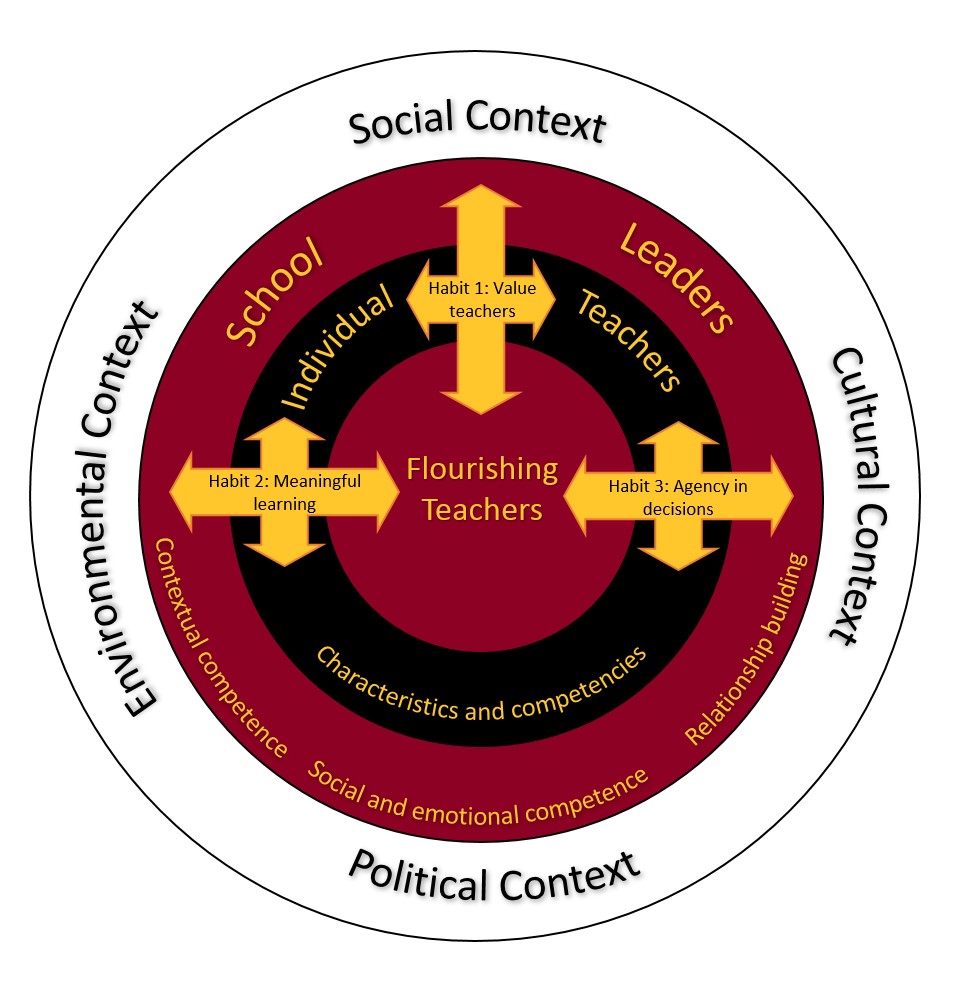
Model of positive school leadership for flourishing teachers. Reprinted with permission from Cann (2019).

Flourishing teachers are placed at the centre of the model, with the surrounding circles and arrows indicating the factors that enable teacher to flourish.

The next level is the individual teachers, and their characteristics and competencies – for example, a teacher’s level of optimism, or coping skills can influence their wellbeing.

The next level are school leaders, and three areas that influence their interactions with teachers: contextual competence (a leader’s ability to understand and respond to context), social and emotional competence, and relationship building.

The outer circle represents contexts that are often outside of teachers or leader’s direct control, for example political context can refer to educational policy.

The three arrows in the model represent leadership habits (actions repeated regularly over time) that can positively influence teachers’ wellbeing:

  • ensuring teachers feel that they are valued,
  • providing meaningful professional development, and
  • enabling teacher agency in decision making and changes.

The three habits are shown interacting with both leaders and teacher’s characteristics and competencies – for example school leaders’ skills in areas such as relationship building, affect the degree to which they are able to successfully enact the habits that can improve teacher wellbeing, and what makes professional development meaningful to a teacher will depend on their existing skills and their own needs. (More information on the model can be found in my thesis here and a journal article here).

Why these findings are important

Teacher wellbeing is not only important to the teachers themselves, but also to the profession as a whole, and ultimately for the students in our education system. Improving teacher wellbeing has the potential to help reduce attrition and ensure quality teaching. A focus on teacher wellbeing has also been identified as a first step in whole-school approaches to improving the wellbeing of students. Whilst some research has explored interventions aimed at improving teacher wellbeing, they are predominantly focused on changing individual teachers’ skills, habits and routines, through practices such as mindfulness, building resilience and managing stress. More research is needed on how school cultures and educator interactions influence wellbeing. This research reinforces the importance of positive relationships for wellbeing, and demonstrates that the quality of leader-teacher interactions has a considerable influence on teacher wellbeing.


Rachel Cann is a PhD student at the University of Auckland. She completed her Master’s thesis on the actions that educational leaders can take to help enhance teacher wellbeing. She continues to explore teacher wellbeing for her doctoral studies, in particular using the perspectives of positive psychology and social network theory. Previously, Rachel was a head of science in an Auckland secondary school, and has also led cross-curricular teams of teachers for project-based learning, pastoral care, and teaching as inquiry.

Wednesday, July 22, 2020

Black Lives Matter Kaupapa Korero Aotearoa context

Attended panel discussion

People, Place and Politics

21st Jul 2020 5:45pm
A conversation about engaging with Black Lives Matter in a Waikato context.
Featuring University of Waikato academics and students, this panel discussion will explore questions raised from a local perspective of the Black Lives Matter movement. This kōrero will cover acknowledging and challenging privilege, the place of monuments, memorialisation and historical reminders, and the power of language in naming conventions as part of reclaiming ownership.
This panel will be facilitated by University of Waikato Deputy Vice-Chancellor Māori,  Sarah-Jane Tiakiwai. Moderated audience questions will form part of the discussion.

Panellists:

Kyla Campbell-Kamariera (Te Rarawa, Te Aupōuri, Taranaki Tūturu), President, Waikato Students’ Union
From rural roots in Northland, Kyla has been described as a trailblazing mana wahine. Currently studying towards a Master of Māori and Indigenous Studies with a particular focus on Māori student politics and the resurgence of mātauranga Māori in mainstream spaces, Kyla’s goals include becoming Vice-Chancellor of the University of Waikato.
Sandra-Lee Ringham (Ngāti Kuri), Teaching Fellow, Doctoral candidate
Sandi’s doctoral thesis explores the geographies of Ngāti Kuri women as they build mana wahine identities and relationships with and in various forms of ‘Nature’ spaces. She teaches Māori and indigenous geographies as well as Māori resource management, giving geography and environmental planning students an understanding of the complexities of colonisation in resource management.
Professor Robyn Longhurst, Deputy Vice-Chancellor Academic
Professor Longhurst has a long-standing interest in gender, equity and social justice. Her research has been in the broad areas of social and cultural geography, with a particular interest in embodiment.  She has taught many classes over the years on expressions of power and meaning in landscapes, including public art, monuments and memorialisation.

Monday, June 25, 2018

Cultural Responsiveness

Did you know?

When learning celebrates (and allows students to draw from) their culture, identity and background, their sense of well-being and belonging increases, and so does their overall achievement. Curriculum, classrooms and wider school environments should acknowledge and celebrate all of the cultures present in that community.
Link: Ministry of Education (2013) Ka Hikitia: Accelerating Success 2013-2017

Monday, May 28, 2018

Hukanui Marae


stuff.co.nz/waikato-times Hukanui Marae


Pepeha
Ko Taupiri te maunga
Ko Waikato te awa
Ko Tainui te waka
Ko Tainui te iwi
Ko Ngāti Wairere te hapū
Ko Hukanui te marae
Ko Kirikiriroa ki te rawhiti te kura
Tū Tangata, Tū Māia

Ko Pippa Wright taku ingoa ko au te tumuaki


Te Tuturu-a-Papa Kamutu - enduring ties to the land

Tawhiao said:
“Waiho nga tatau o taku whare kia tuwhera mo te hunga e haere ana i te huarahi e kaingia ana e te namu”  - (Leave the doors of my house open for travellers on the path who have been ravaged by the mosquito).

Hukanui connects ancestrally to the Tainui waka.

Sunday, November 13, 2016

Spoken Word: "Invisible Privilege" by Sacha Norrie

An enlightening poem...


White Privilege

What Do We Tell The Children?

what-should-we-tell-the-children_?

Tell them "bigotry is not a democratic value, and that it will not be tolerated at our school."

A strong response from our learners re the US election.
Fear
Outrage
Anger

Consternation .... and being able to talk about our Toolkit and Donald Trump . 
We challenge views and assumptions. 
 What has happened? 
 What are you going to do about it?
"Call Trump and say please don't make World War 3"

Saturday, November 12, 2016

White Privilege: Unpacking the Invisible Knapsack Peggy McIntosh


 A sobering reminder when leading a school more than 2/3 Non 'white '

White Privilege: Unpacking the Invisible Knapsack Peggy McIntosh

"I was taught to see racism only in individual acts of meanness, not in invisible systems conferring dominance on my group"


Through work to bring materials from women's studies into the rest of the curriculum, I have often  noticed men's unwillingness  to grant that they are over privileged, even though they may grant that   women are disadvantaged.  They may say they will work to women's statutes, in the society, the   university, or the curriculum, but they can't or won't support the idea of lessening men's. Denials that amount to taboos surround the subject of advantages that men gain from women's disadvantages. These denials protect male privilege from being fully acknowledged, lessened, or ended.

Thinking through unacknowledged male privilege as a phenomenon, I realized that, since hierarchies  in our society are interlocking, there are most likely a phenomenon, I realized that, since hierarchies in our society are interlocking,  there was most  likely a phenomenon  of while privilege  that was  similarly denied and protected. As a white person, I realized I had been taught about racism as something that puts others at a disadvantage, but had been taught not to see one of its corollary aspects, white privilege,
which puts me at an advantage.

I think whites are carefully taught not to recognise white privilege, as males are taught not to recognize male privilege. So I have begun in an untutored way to ask what it is like to have white privilege. I have come to see white privilege as an invisible package of unearned assets that I can count on cashing in   each day, but about which I was "meant" to remain oblivious. White privilege is like an invisible weightless knapsack of special provisions, maps, passports, codebooks, visas, clothes, tools, and blank checks.

Describing white privilege makes one newly accountable. As we in women's studies work to reveal male privilege and ask men to give up some of their power, so one who writes about having white privilege must ask, "having described it, what will I do to lessen or end it?"

After I realized the ·extent to which men work from a base of unacknowledged  privilege,  I understood that much of their oppressiveness was unconscious . Then I remembered the frequent charges from women of color that white women whom they encounter are oppressive. I began to understand why we  are just seen as oppressive, even when we don't see ourselves that way. I began to count the ways in  which I enjoy unearned  skin privilege  and have been conditioned  into oblivion  about its  existence.

My schooling gave me no training in seeing myself as an oppressor, as an unfairly advantaged person, or  as a participant in a damaged culture. I was taught to see myself as an individual whose moral state depended on her individual moral will. My schooling followed the pattern my colleague Elizabeth     Minnich has pointed out: whites are taught to think of their lives as morally neutral, normative, and  average, and also ideal, so that when  we work to benefit  others, this is seen as work that will allow    "them" to be more like "us"


Daily effects of white privilege

I decided to try to work on myself at least by identifying some of the daily effects of white privilege in my life. I have chosen those conditions that I think in my case attach somewhat more to skin-color privilege than to class, religion, ethnic status, or geographic location, though of course all these other factors are intricately intertwined. As far as I can tell, my African American coworkers, friends, and acquaintances with whom I come into daily or frequent contact in this particular time, place and time of work cannot count on most of these conditions.

1.     I can if l wish arrange to be in the company of people of my race most of the time.

2.   I can avoid spending time with people whom I was trained to mistrust and who have learned to mistrust my kind or me.

3.   If I should need to move, I can be pretty sure of renting or purchasing housing in an area which I can afford and in which I would want to live.

4.    I can be pretty sure that my neighbours in such a location will be neutral or pleasant to me.

5.    I can go shopping alone most of the time, pretty well assured that I will not be followed or harassed.

I know what many of our immigrant families experience because they have told me ....

6.   I can tum on the television or open to the front page of the paper and see people of my race widely represented. Positively....

7.     When I am told about our national heritage or about "civilisation," I am shown that people of my colour made it what it is.

8.    I can be sure that my children will be given curricular materials that testify to the existence of their race.

9.     If   I want to, I can be pretty sure of finding a publisher for this piece on white privilege.

I 0. I can be pretty sure of having my voice heard in a group in which I am the only member of my race.

11.     I can be casual about whether or not to listen to another person's voice in a group in which s/he is the only member of his/her race.

12.      I can go into a music shop and count on finding the music of my race represented, into a supermarket and find  the staple foods which fit with my  cultural  traditions,  into a hairdresser's  shop and find  someone  who  can cut my hair.

13.     Whether I use checks, credit cards or cash, I can count on my skin colour not to work against the appearance of  financial reliability.

14.     I can arrange to protect my children most of the time from people who might not like them.

15.    I do not have to educate my children to be aware of systemic racism for their own daily physical protection.

16.    I can be pretty sure that my children's teachers and employers will tolerate them if they fit school and workplace norms; my chief worries about them do not concern others' attitudes toward their race.

17.    I can talk with my mouth full and not have people put this down to my color.

18.     I can swear, or dress in second hand clothes, or not answer letters, without having people attribute these choices to the bad morals, the poverty or the illiteracy of my race.

19.     I can speak in public to a powerful male group without putting my race on trial.

20.      I can do well in a challenging situation without being called a credit to my race.

21.     I am never asked to speak for all the people of my racial  group.

22.      I can remain oblivious of the language and customs of persons of color who constitute the world's majority without feeling in my culture any penalty for such oblivion.

23.     I can criticize our government and talk about how much I fear its policies and behavior without being seen as a cultural outsider.

24.      I can be pretty sure that if l ask to talk to the "person in charge", I will be facing a person of my race.

25.      If a traffic cop pulls me over or if the IRS audits my tax return, I can be sure I haven't been singled out because of my race.

26.      I can easily buy posters, post-cards, picture books, greeting cards, dolls, toys and children's magazines featuring people of my race.

27.      I can go home from most meetings of organizations I belong to feeling somewhat tied in, rather than isolated, out-of-place, outnumbered, unheard, held at a distance or feared.

28.      I can be pretty sure that an argument with a colleague of another race is more likely to jeopardize her/his chances for advancement than to jeopardize mine.

29.      I can be pretty sure that if I argue for the promotion of a person of another race, or a program centering on race, this is not likely to cost me heavily within my present setting, even if my colleagues disagree with me.

30.      If l declare there is a racial issue at hand, or there isn't a racial issue at hand, my race will lend me more credibility for either position than a person of color will have.


31.      I can choose to ignore developments in minority writing and minority activist programs, or disparage them, or learn from them, but in any case, I can find ways to be more or less protected from negative consequences of any of these choices.

32.     My culture gives me little fear about ignoring the perspectives and powers of people of other  races.

33.      I am not made acutely aware that my shape, bearing or body odor will be taken as a reflection on my race.

34.   I can worry about racism without being seen as self-interested or self-seeking.

35.      I can take a job with an affirmative action employer without having my co-workers on the job suspect that I got it because of my race.

36.      If my day, week or year is going badly, I need not ask of each negative episode or situation whether it had racial overtones.

37.      I can be pretty sure of finding people who would be willing to talk with me and advise me about my next steps, professionally.

38.      I can think over many options, social, political, imaginative or professional, without asking whether a person of my race would be accepted or allowed to do what I want to do.

39.      I can be late to a meeting without having the lateness reflect  on my race.

40.       I can choose public accommodation without fearing that people of my race cannot get in or will be mistreated in the places I have chosen.  ·

41.      I can be sure that if I need legal or medical help, my race will not work against me.

42.      I can arrange my activities so that I will never have to experience feelings of rejection owing to my race.

43.    If l have low credibility as a leader I can be sure that my race is not the problem.

44.       I can easily find academic courses and institutions which give attention only to people of my race.

45.      I can expect figurative language and imagery in all of the arts to testify to experiences of my race.

46.      I can choose blemish cover or bandages in "flesh" color and have them more or less match my skin.

47.      I can travel alone or with my spouse without expecting embarrassment or hostility in those who deal with us.

48.      I have no difficulty finding neighborhoods where people approve of our household.

49.     My children are given texts and classes which implicitly support our kind of family unit and do not turn them against my choice of domestic partnership.

50.      I will feel welcomed and "normal" in the usual walks of public life, institutional and  ocial.

Elusive and fugitive


I repeatedly forgot each of the realisations on this list until I wrote it down. For me white privilege has turned out to be an elusive and fugitive subject. The pressure to avoid it is great, for in facing it I must give up the myth of meritocracy. If these things are true, this is not such a free country; one's life is not what one makes it; many doors open for certain people through no virtues of their   own.

In unpacking this invisible knapsack of white privilege, I have listed conditions of daily experience that    I once took for granted. Nor did I think of any of these perquisites as bad for the holder. I now think that we need a more finely differentiated taxonomy of privilege, for some of these varieties are only what  one would want for everyone in a just society, and others give license to be ignorant, oblivious, arrogant, and destructive.

I see a pattern running through the matrix of white privilege, a patter of assumptions that were passed on to me as a white person. There was one main piece of cultural turf; it was my own tum, and I was among those who could control the turf. My skin color was an asset for any move I was educated to want to  make. I could think of myself as belonging in major ways and of making social systems work for me. I could freely disparage, fear, neglect, or be oblivious to anything outside of the dominant cultural forms. Being of the main culture, I could also criticize it fairly freely.

In proportion as my racial group was being made confident, comfortable, and oblivious, other groups were likely being made unconfident, uncomfortable, and alienated. Whiteness protected me from many kinds of hostility, distress, and violence, which I was being subtly trained to visit, in turn, upon people  of color.

For this reason, the word "privilege" now seems to me misleading. We usually think of privilege as being a favored state, whether earned or conferred by birth or luck. Yet some of the conditions I have described here work systematically to over empower certain groups. Such privilege simply confers dominance because of one's race or sex.

Earned strength, unearned power


I want, then, to distinguish between earned strength and unearned power conferred privilege can look    like strength when it is in fact permission to escape or to dominate. But not all of the- privileges on my   list are inevitably damaging. Some, like the expectation that neighbors will be decent to you, or that your race will not count against you in court, should be the norm in a just society. Others, like the privilege to ignore less powerful people, distort the humanity of the holders as well as the ignored groups.


We might at least start by distinguishing between positive advantages, which we can work to spread, and negative types of advantage, which unless rejected will always reinforce our present hierarchies. For example, the feeling that one belongs within the human circle, as Native Americans say, should not be seen as privilege for a few. Ideally it is an unearned entitlement. At present, since only a few have it, it is an unearned advantage for them. This paper results from a process of coming to see that some of the  power that I originally say as attendant on being a human being in the United States consisted in   unearned advantage and conferred  dominance.

I have met very few men who truly distressed about systemic, unearned male advantage and conferred dominance. And so one question for me and others like me is whether we will be like them, or whether we will get truly distressed, even outraged, about unearned race advantage and conferred dominance,   and, if so, what we will do to lessen them. In any case, we need to do more work in identifying how they actually affect our daily lives. Many, perhaps most, of our white students in the United States think that racism doesn't affect them because they are not people of color; they do not see "whiteness" as a racial identity. In addition, since race and sex are not the only advantaging systems at work, we need similarly  to examine the daily experience of having age advantage, or ethnic advantage, or physical ability, or advantage related to nationality, religion, or sexual  orientation.

Difficulties and angers surrounding the task of finding parallels are many. Since racism, sexism, and heterosexism are not the same, the advantages associated with them should not be seen as the same. In addition, it is hard to disentangle aspects of unearned advantage that rest more on social class, economic class, race, religion, sex, and ethnic identity that on other factors. Still, all of the oppressions are interlocking, as the members of the Combahee River Collective pointed out in their "Black Feminist Statement" of 1977.

One factor seems clear about all of the interlocking oppressions. They take both active forms, which we can see, and embedded forms, which as a member of the dominant groups one is taught not to see. In my class and place, I did not see myself as a racist because I was taught to recognize racism only in  individual acts of meanness by members of my group, never in invisible systems conferring unsought racial dominance on my group from  birth.

Disapproving of the system won't be enough to change them. I was taught to think that racism could end if white individuals changed their attitude. But a "white" skin in the United States opens many doors for whites whether or not we approve of the way dominance has been conferred on us. Individual acts can palliate but cannot end, these problems.

To redesign social systems we need first to acknowledge their colossal unseen dimensions. The silences and denials surrounding privilege are the key political surrounding privilege are the key political tool here. They keep the thinking about equality or equity incomplete, protecting unearned advantage and conferred dominance by making these subject taboo. Most talk by whites about equal opportunity seems to me now to be about equal opportunity to try to get into a position of dominance while denying that systems of dominance exist.

It seems to me that obliviousness about white advantage, like obliviousness about male advantage, is kept strongly inculturated in the United States so as to maintain the myth of meritocracy, the myth   that

democratic choice is equally available to all. Keeping most people unaware that freedom of confident action is there for just a small number of people props up those in power and serves to keep power in the hands of the same groups that have most of it already.


Although systemic change takes many decades, there are pressing questions for me and, 'I imagine, for some others like me if we raise our daily consciousness on the perquisites of being light-skinned. What will we do with such knowledge? As we know from watching men, it is an open question whether we will choose to use unearned advantage, and whether we will use any of our arbitrarily awarded power to try to reconstruct power systems on a broader base.


Peggy McIntosh is associate director of the Wellesley College Center for Research on Women. This essay is excerpted from Working Paper 189. "White Privil ege and Male Privilege: A Personal Account of Coming To See Correspondences through Work in Women's Studies" (1988), by Peggy McIntosh; available for $4.00from the Wellesley College Centerfor Research on Women, Wellesley MA 02181 The working paper contains a longer list of privileges. This excerpted essay is reprinted from the Winter 1990 issue of Independent School